Richard C McNeff
Author
WHILE WE YET LIVE
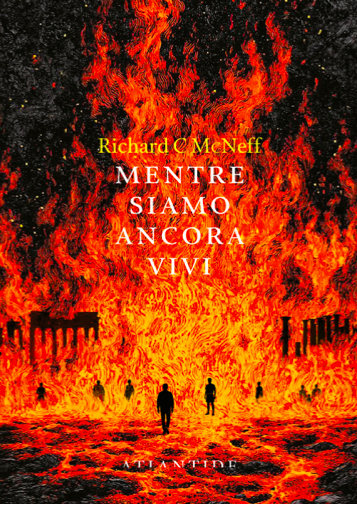
|
From the reviews:
“While We Yet Live is an unusual book, a little metaphysical but also tenaciously telluric, wise, playing with time, placing the past and present side by side, like two images reflected in a mirror from ancient times…Imperial Rome is presented to us with all its historical power; it is a living, noisy, sensual, and ambivalent world…This is a multilayered novel, rich in inspiration.”
Marilu Oliva, Huffington Post
“One of the most fascinating possibilities offered by historical fiction is entering the spaces left empty by history…While We Yet Live transforms this intuition into an adventure between history and fantasy.”
Libreriamo
“A parallel between the wild hedonism of modern Ibiza and Neronian Rome is the linchpin of While We Yet Live…For once, the flaps don’t lie, they don’t exaggerate, they don’t let themselves go…It has the pace of an adventure story and the preoccupations of a novel of ideas…The closing of the circle, the alignment of the planets in the writing and structure of the book, has materialized after decades, and the result is nothing short of excellent.”
LuciaLibri
INTERVIEW
How did this novel come to you?
While living on Ibiza in the mid-1980s, I read that the Balearic Islands were well- known in Roman times for the “copious and honeyed life” (la dolce vita). Looking around me, it seemed little had changed. There were wealthy expats, impoverished artists, exiles and criminals, all hunting the island’s main export – pleasure. The idea came to me of writing a novel in which the vivid life around me could find a mirror in the Roman era.
Why has it been so long in gestation?
The first draft was set solely in the first century, narrated by a Roman exile on Ibiza. But why was he stranded there? Who was he linked to in Rome? It was then that I discovered Petronius, who was Nero’s Arbiter of Elegance, responsible for the taste of the court, be it furnishings or food, as well as the author of the great picaresque novel The Satyricon. Celebrated like Oscar Wilde for his wit and lucidity, he notoriously slept all day and lived at night, just like many around me. The book kept evolving and acquired a modern part, the characters and events obliquely mirroring the Roman section, until old and new converged. With the addition of a time-travel element, it became at times like negotiating a maze. I left the book on more than one occasion. Finally, when everything fitted together, forty years had passed.
What does this book represent to you? In what ways did it change you as a writer and as a person, too?
Both time frames partly reflect my own experience. One mirror is the one held up to my youth. Early drafts were quite cavalier about historical verisimilitude. However, I realised that a properly researched historical background made the speculative elements more convincing. Similarly, the prose became less verbose, less prone to repetition and adjective-heavy, as time taught me to place more value on economy and precision, in life as well as art.
Why did you choose Ancient Rome and Ibiza/Ebusus?
There are notable examples of books that anticipate the future. But what if a similar feat of imagination could authentically evoke the past? It was not just the ruthless hedonism of Ibiza that mirrored Rome, but also the sexual licence and pagan sensibility. I was mingling with astrologers, sun worshippers, devotees of strange religions. The names of gods and goddesses sprang to their lips almost as readily as they had to the Romans, making me only more determined to explore the parallel.
WHILE WE YET LIVE – EXCERPTS
We disembarked onto a jetty and, with our ferryman leading the way, ascended a gloomy shaft that levelled out into a trapezoidal passageway. At the end stood a doorway, shaped like a vulva. Oak leaves crunched beneath our feet as we entered the grotto.
The Sibyl sat on a tripod framed by a stalactite-roofed chasm that coalesced behind her into a black hole. At her feet lay a mottled, undistinguished jar and more oak leaves. After singing the fates, she wrote her prophecies on these and stacked them before the door. But the wind invariably disordered them. This is why the Sibylline Oracles are so difficult to decipher, as the priestess does nothing to repair this. In her robe of rich scarlet, the Sibyl was a handsome, middle-aged woman, and her voice was clear and well-modulated as she said in Greek,
‘We welcome you, Arbiter and Outcast!’
We? There was nobody else there! And what was this about “Outcast”, assuming she meant me? Petronius asked where the opening behind her led.
‘Avernus, the ghostly lake, and the whispering groves of Hades, where the souls wait a thousand years to return and inhabit the living. The gate of the Underworld is open. You will find generations of your ancestors waiting for you, or perhaps you are them already. The journey is short and easy. But the return is fraught with hazard. I doubt that you will make it.’
‘Nor will we try. We have come to interrogate the future.’
Fumes jetting from fissures in the rock spiralled upwards and haloed her gold-silver tresses. She inhaled deeply, her eyes lost focus, and her face grew contorted. She stretched her arms out hieratically, revealing bruises from previous convulsions. She recited a jumble of Greek hexameters, none of which made sense, except that we learnt that her name was Taraxandra. Petronius glanced hopelessly at me and shrugged.
The pneuma enveloped us, too. I felt light-headed as the fumes irritated my throat. Then the visions came. A city burning; an island floating on a shimmering sea; a man, who was and wasn’t me, standing over a stricken woman. Taraxandra’s voice was shrill one moment, husky the next, the words garbled. But suddenly a phrase of unusual clarity leapt out: ‘It is time to question the Oracle, behold the god! The god!’
Would her channelling now make sense? Would Apollo grace us with authentic divinations? Instead, another voice rose from the spout of the jar, an ancient rasp that sounded infinitely weary.
‘Do you still want more? Is it not enough that I delivered nine, which became six and then three beneath the seven hills?’
Baffling numerological riddles are what you expect from the Oracle, yet her words made immediate sense. More than 500 years ago, the Sibyl, Deiphobe, offered the last king of Rome nine books of prophecies. Tarquinus Superbus refused her price, so she burnt three in front of him. He declined again, so more reams of priceless portents went up in smoke. Finally, he bought the three remaining books at the original price. The Sibylline Books were kept in the Temple of Jupiter and consulted in times of peril until fire razed the building 150 years ago.
‘My ancestor, Petronius Sabinus, copied your books.’
‘Yes, I remember him. He looked like you.’
‘You have spoken of the past. Now tell us of the future.’
‘Three sixes will succumb to four but resolve into one who will guide the empire like a mule to plenitude. The second born will rule by terror. Five wise heads will broaden the horizon, and a mad priest of the sun will violate the shrine. The cross will eclipse the Oracle, the sacred breath expire, and we will sing no more.’
I could see this made as little sense to Petronius as it did to me.
‘Where are you hiding, Deiphobe?’ he said.
‘When I dallied with Apollo on a beach, he granted me two wishes if I would sleep with him: the power of divination and as many years as the grains of sand I spilt onto his palm. But I jilted him, and having neglected to ask for eternal youth, he left me to wither until I was so small that only this jar could hold me. Now just my voice lingers to tell Petronius he will go laughing to his tomb.’
‘What do you want, Sibyl?’
The clefts and ridges of the travertine rock arching over our heads became lips that raved like Taraxandra’s, signifying nothing. Only the voice in the jar made sense.
‘I want to die.’
2.
Petrus’s grey eyes bored into him. ‘What if I told you, it is possible to visit those eras, not through a time machine diving through wormholes, but via a drug?’
‘You’d be echoing Miquel.’
‘Ah, the soul of indiscretion!’ Petrus chuckled.
Marc remembered reading that if a time traveller dislodged a pebble in the Mesozoic Era, dinosaurs would still be roaming New York. ‘Without altering the present?’
‘You’re like a ghost. There’s no chance of bringing back a souvenir.’
‘Yeah, you’re just an extra in the movie.’ Miquel squinted up at them from the deck. ‘A hussar’s bugle could take you to the plains of Waterloo, a bullet from Dallas to the grassy knoll, and you’d find out who shot Kennedy.’
Petrus gazed at Marc. ‘Would you like to be a chrononaut?’
But I already am, his interlocutor thought, and the scrolls are my time machine. Only the fifth remained, inscribed on rough parchment rather than papyrus. That was a puzzle, as was Satyrion’s fate aboard Theodosia’s boat.
Petrus delved into the pocket of his shorts and pulled out a glass eyedropper.
Miquel waved excitedly at the sea. ‘Without an object to direct you, it can get quite random. You might see Venetian galleys, galleons, or corsair brigantines.’
‘Or you could go there.’ Petrus gestured in the direction of Ahorcados.
‘And what might I find?’
‘Perhaps the end of something.’
‘Or somebody,’ grinned Miquel.
‘But you will have a guide,’ said Petrus, twisting the signet ring from his finger and handing it over.
Marc scrutinised the gold band resting on his palm. It was set with a rock crystal gemstone, behind which glowed a holographic form. The artisan had carved into the stone’s volume on the back to create the three-dimensional illusion of a swan beneath a crescent moon. Marc slipped it onto his finger. As neutrally as he could, he asked Petrus where he had got it.
‘It’s been in the Italian side for generations. The ancestor who had it made fell out of favour and tried to destroy it. But it stayed in the family, and they had it restored. Not entirely successfully. Look at those marks on the band and the dent on the cabochon!’
‘Why did he want to destroy it?’
‘So, our family crest could not be used as a seal to incriminate others.’
Petrus unscrewed the pipette on the eyedropper and squeezed a single drop into Marc’s pupils. Everything went blurry, but he blinked rapidly, and his vision slowly began to clear. He took off his T-shirt, shook the espadrilles off his feet, and removed his shorts.
Clad in black swimwear, he fumbled his way along the rail to the starboard hull, crouched, and slid into the sea. He plunged underwater, full of nervous anticipation. It was like being a traveller about to cross the frontier of an undiscovered country. Emit, however, was unlike anything he had experienced.
Made at the tip of Africa. ©